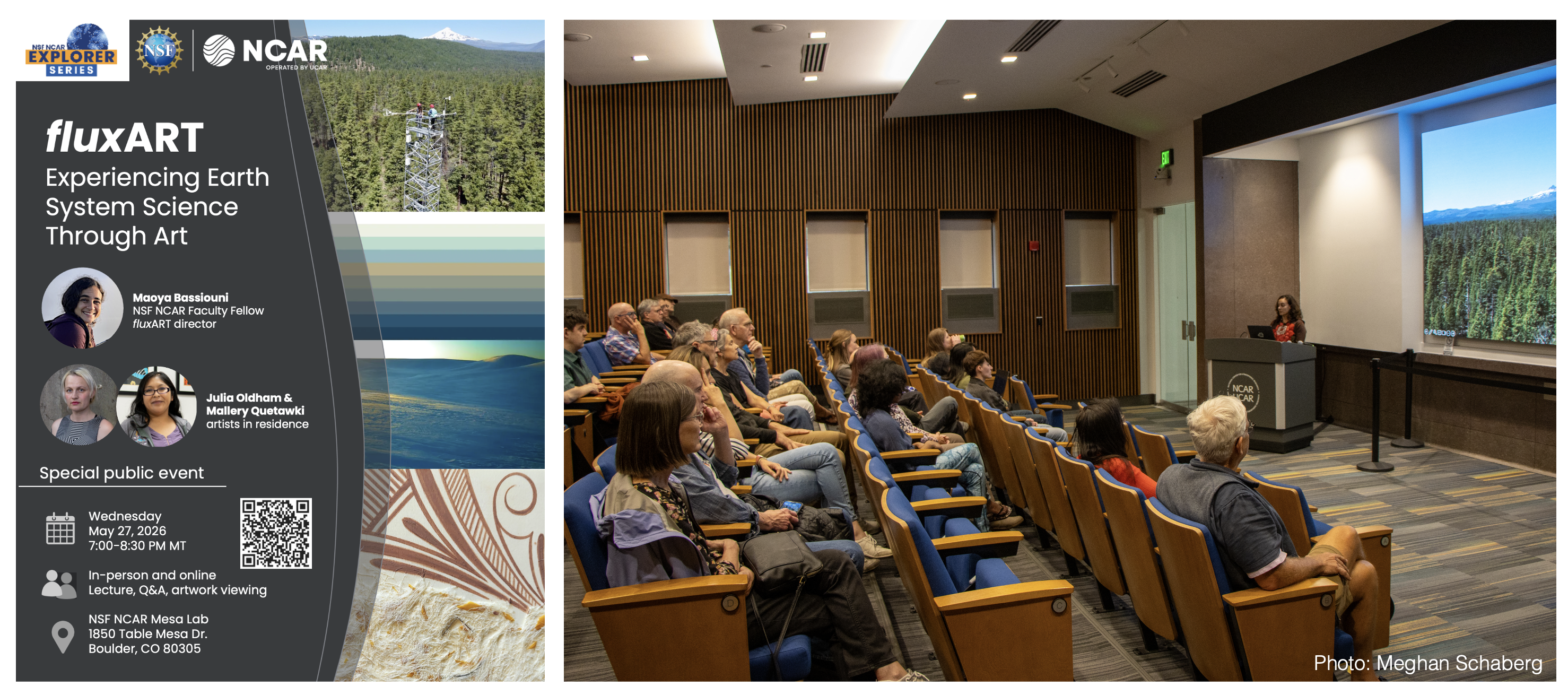
In May 2026, fluxART collaborated with NSF NCAR EdEC on a special public event at the Mesa Lab in Boulder, Colorado, engaging both scientific and public audiences .
As part of her NSF NCAR Faculty Fellowship, Maoya Bassiouni spoke in NSF NCAR’s Explorer Lecture Series alongside artists Julia Oldham and Mallery Quetawki. Together, they shared how creative practice can deepen our relationship with terrestrial ecosystem processes represented in NSF NCAR’s Community Earth System Model. The event introduced audiences to FLUXNET’s global network of land-atmosphere exchange observations, data that underpin water and carbon cycle modeling and research at NSF NCAR, while also offering a creative invitation to reflect on and experience these same processes through art.
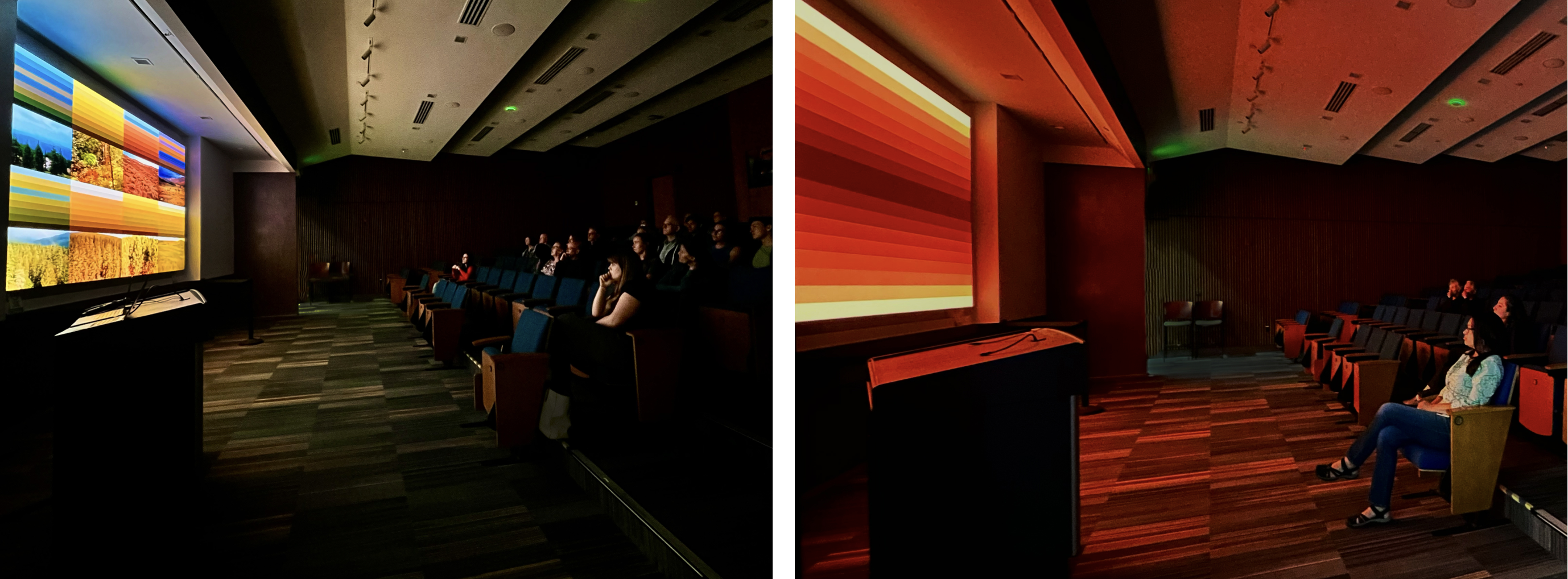
In addition to the lecture, the Mesa Lab hosted screenings of Julia Oldham’s September: Orange on May 26 and 27, 2026. Julia’s work offered a sensory and mysterious experience of long-term ecological data from the PhenoCam network, attended by approximately 90 people.
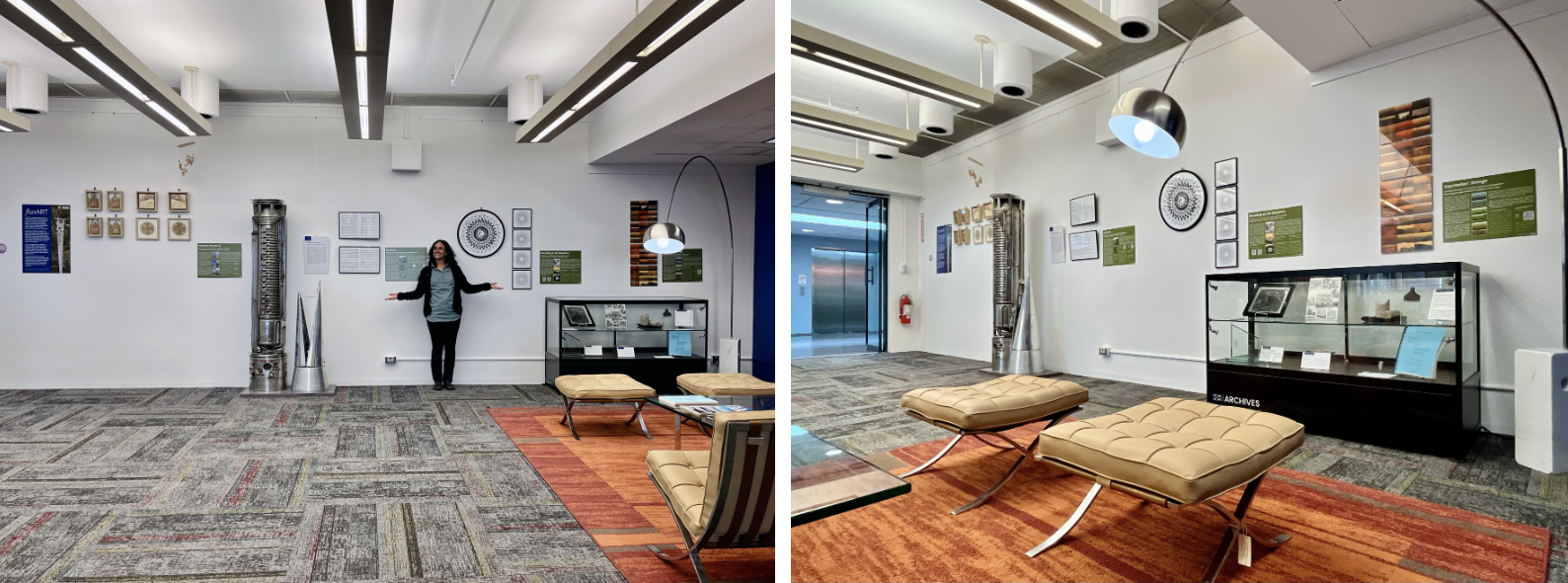
Artworks and art-science didactics from fluxART projects are currently on view in the Mesa Lab Library. They will remain on exhibit from May 27 through December 31, 2026, offering an ongoing space to encounter flux science and data with a new creative curiosity.
Exhibition at NCAR Mesa Laboratory
Yeh’chuna:we (Breathing in), Mallery Quetawki, 2025, natural clay and pigments, yucca plant fibers, 5" x 7" (x4)
Yanhaku, Mallery Quetawki, 2025, natural clay and pigments, 4" x 24" (windchime)
Fire, from En Masse, Sara Bouchard, 2025, score with data sonification for STAB and drums, digital print, 17" x 11"
Soil, from En Masse, Sara Bouchard, 2025, score for STAB and drums, digital print, 17" x 11"
Flux Mandala, daily, Maoya Bassiouni, 2025, data visualization, digital print 19" x 19"
Flux Mandala, seasonal, Maoya Bassiouni, 2025, data visualization, digital print 8" x 8" (x4)
September: Orange, Julia Oldham, 2025, video stills, digital print 12" x 9" (x4)
We thank our partnership with NSF NCAR EdEC and the Mesa Lab Library as well as support from the NSF NCAR Faculty Fellowship Program. fluxART is made possible through the FLUXNET Community Coordination Project supported by the NSF AccelNet Award 2113978, the USDA NIFA Award 2023-67012-40086, Virginia Commonwealth University, and the PRAx L.L. Stewart Faculty Fellowship. Flux tower research sites featured in fluxART projects are supported by the AmeriFlux Management Project funded by the US DOE Office of Science BER program. Data was also provided by the PhenoCam Network.